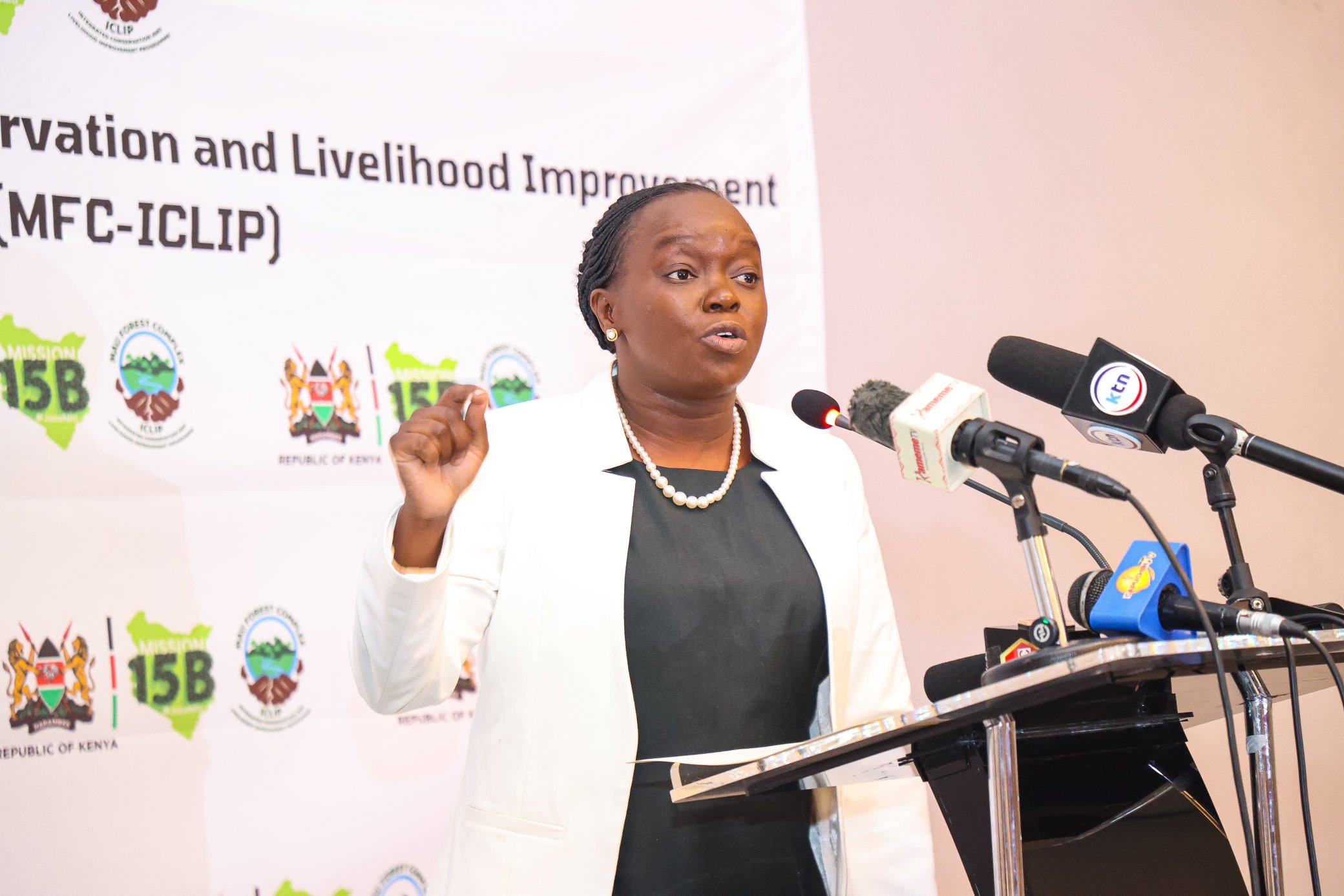
Environment Cabinet Secretary Deborah Barasa has ordered all forest stations across the country to immediately scale up operations and produce at least one million seedlings each, as Kenya intensifies efforts to attain 30 per cent tree cover.
The directive was issued on Thursday during her inspection of the Kinale Forest tree nursery in Kiambu County, which she described as a strategic facility in the country’s national tree growing and restoration programme.
Addressing forest managers and Kenya Forest Service (KFS) leadership at Kinale, CS Barasa stressed that the government now expects visible, measurable action on the ground.
“I want to see action in every forest station,” she said, directing that each station must be fully prepared to meet the one-million-seedling target.
To ensure accountability, she instructed that photographic evidence and detailed progress reports be submitted to track production and outcomes.
The CS reiterated that large-scale seedling production remains the backbone of Kenya’s environmental conservation and climate action agenda, noting that nurseries such as Kinale will be central to supplying quality seedlings for both government-led programmes and community initiatives.
During the inspection, Chief Conservator of Forests, Alex Lemarkoko, emphasized the importance of the Kinale Forest nursery, citing its strategic location along a major highway.
He noted that the accessibility presents “a unique opportunity for citizens to purchase seedlings as they travel,” thereby encouraging tree planting at household and community levels and expanding public participation in conservation efforts.
To boost production capacity, KFS has already supplied one million planting tubes to the nursery. However, labour shortages remain a major challenge. In response, KFS has employed 85 casual workers under the Greenzone Project, with further plans underway to involve the National Youth Service (NYS) to strengthen the workforce and accelerate seedling production.
“The biggest challenge is that many people do not fully understand the magnitude and effort involved in producing seedlings at this scale,” Lemarkoko said, adding that nursery development demands significant investment in materials, labour and technical expertise to ensure quality and survival rates.
Community participation has also been identified as a key pillar of success. Kinale Community Forest Association (CFA) Chairman, Dominic Chui, affirmed strong collaboration between local communities and KFS.
He said CFAs are working closely with forest managers to promote local involvement and ownership in forest restoration initiatives.
With CS Barasa’s directive now in place, the Kinale Forest nursery is expected to play a critical role in meeting national targets, marking a significant step forward in Kenya’s journey towards a greener and more climate-resilient future.




























Comments
Sign in with Google to comment, reply, and like comments.
Continue with Google